What is churchkhela? Georgia’s candy made from grape must and walnuts
It hangs like a candle at every market stall and tastes of a Georgian autumn: walnuts on a string, dipped again and again in thickened grape must. What’s in it, how it’s made and how to eat it.
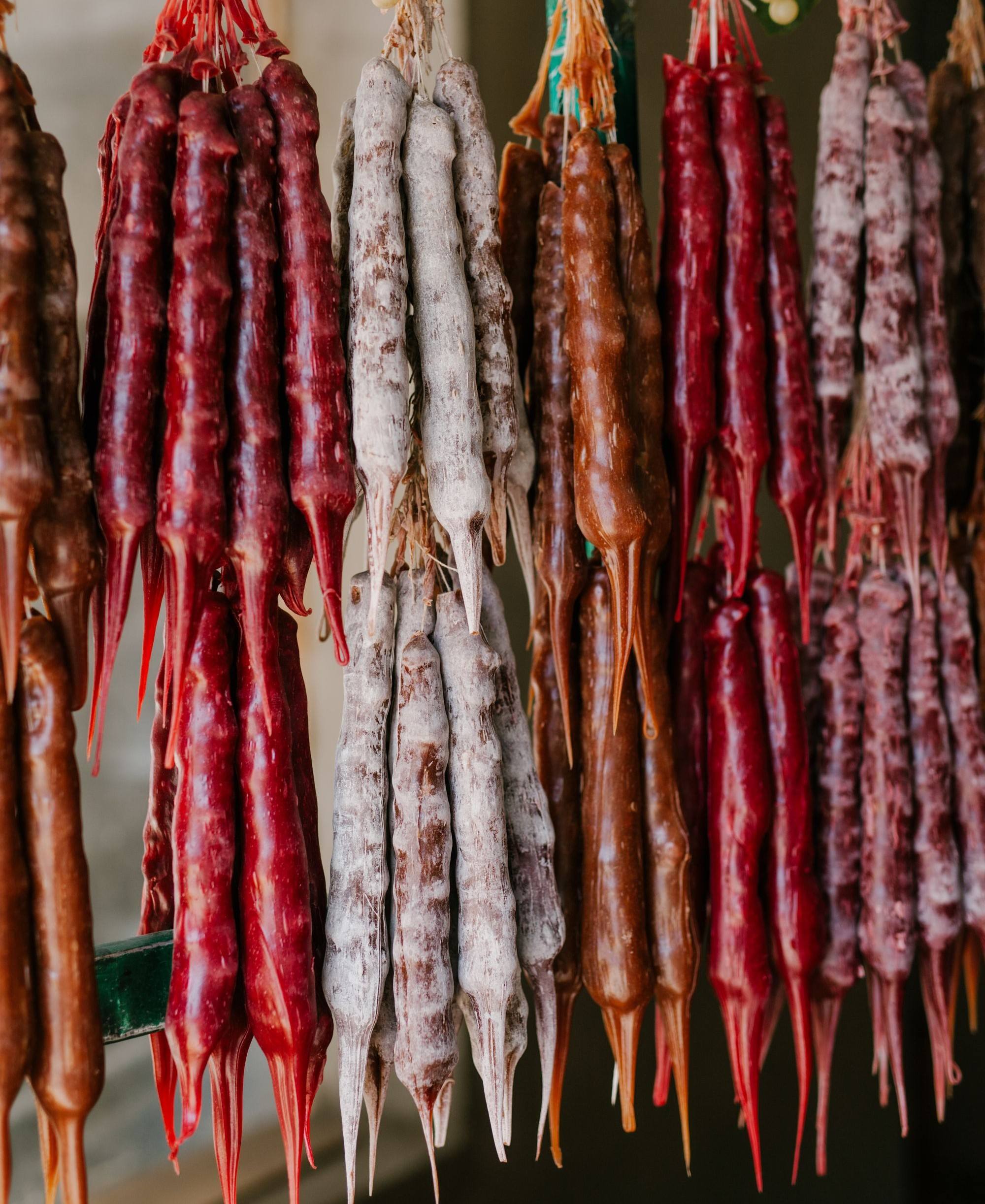
Walk through any market in Georgia and you’ll spot them straight away: long, glossy strands in deep red, amber and rosé, hanging in rows from poles. From a distance they look like candles. This is churchkhela (say “choorch-khe-la”), Georgia’s best-known sweet.
I’m Sebastian, and my first churchkhela was at a family celebration in Tbilisi, when I was a small kid. Honestly, I wasn’t a fan at first, because I didn’t much like walnuts. I came round to it the long way: with chocolate on top, or a little honey. At some point I fell in love with the plain version too. And wherever we lived later, after every trip to Georgia our suitcases were full of churchkhela, for all our friends. A good share of it we ate ourselves, of course.
What’s in it?
At its heart, just three things: nuts, grape must and flour.
- Nuts: usually walnuts, often hazelnuts. They’re threaded onto a string.
- Grape must: freshly pressed grape juice, slowly boiled down until it’s thick and concentrated. In Georgia it’s called badagi.
- Flour: it thickens the reduced must into a kind of sweet pudding called tatara.
The sweetness comes from the grapes. That’s what sets churchkhela apart from gummies or snack bars: it’s essentially the grape harvest, concentrated.
How is churchkhela made?
Churchkhela is made in autumn, right after the grape harvest, called rtveli in Georgian. Once the grapes are pressed, some of the must goes to the wine cellar and some into the big pot.
- The must is heated and reduced, then flour is stirred in until the tatara thickens.
- The strung nuts are dipped in, pulled out and dipped again, usually two or three times, until a thick coat has built up.
- The strands then hang from poles to dry in an airy spot, often in the sun. Depending on the weather, this takes from a few days to about two weeks.
- Once dry, they’re wrapped in white cotton cloth and kept somewhere dark and dry.
Good churchkhela is firm and slightly leathery outside, and still soft and a little chewy inside.
East and west: not all churchkhela is the same
Georgia is small, but every region makes its churchkhela a little differently:
- Kakheti in the east, the wine country, is the classic: walnut halves and must thickened with wheat flour.
- In the west, in Guria, Samegrelo and Imereti, there’s often a hazelnut at the core, and corn flour replaces wheat flour.
- In Racha in the north, dried fruit, apricots or pumpkin seeds go onto the string as well.
Instead of grape must, mulberry or other fruit juices are sometimes used, which is where all the colours at the market come from.
A travel food with a history
Churchkhela isn’t only a dessert. Because it’s filling and keeps for a long time without refrigeration, Georgian soldiers used to carry it as provisions. Today it’s a snack between meals, and it belongs on the table at New Year and Christmas.
In 2015, the traditional way of making it in Kakheti was added to Georgia’s list of intangible cultural heritage.
How to spot good churchkhela
- It’s soft. Good churchkhela is easy to chew. If it’s hard as a stick, it’s old or dried too long.
- It smells. Of grapes, of must, a little of autumn. If it smells of nothing, leave it hanging.
- White spots are fine. Don’t be put off: that’s just sugar from the grapes crystallising on the surface.
How do you eat churchkhela?
Simply cut it into slices, about one to two centimetres thick. The string runs through the middle; just pull it out. Churchkhela goes well with a glass of tea, a strong coffee or as the end of a meal.
Our tip: try it with wine. It comes from the same grape, and you can taste it. Sliced, it’s also great on a cheese board.
Keep it dry and dark, ideally wrapped in a cotton cloth rather than plastic, and it will last a long time.
Why we’re doing this
In Georgia it hangs at every market stall. In Hamburg, good churchkhela is still hard to find, and fresh from the latest harvest almost never. We want to change that.
We want to share our culture, but above all connect people through a language everyone speaks: food. And we think an everyday snack can be made of grapes and nuts rather than a long list of ingredients. That’s why we source special products straight from Georgian producers and bring them to Hamburg.
You help decide which ones come first.
Sebastian & Guga